VPT – Care & Use Instructions
Preparing VPT for Use
Washing
- Before use, clean & sanitize your VPT stacker or cylinder, including any valves, sample tap & lid.
- Stackers are easily cleaned using rotating head spray nozzles as used on tanks.
- Red wine stains are easily removed using a caustic soda wash.
- Use cold water and your normal winery sanitizer, eg dilute caustic soda (sodium hydroxide) or similar. Water rinse.
CAUTION: Do not use hot water. Hot water may soften and distort the polymer. Use of hot water on any of the polymer parts (body or lid) is unnecessary and will void warranty.
Orientation of the Main Lid Seal
The orange colored main seal (Item name: Seal, Main, MS2020) has to be fitted the correct way. Fitting the seal upside-down may allow it to leak.
One side of the MS2020 seal has a series of raised ridges and the other side is smooth. Ridges are always to face downwards – facing the wine.
CAUTION: Always ensure the raised ridges on the main lid seal are facing downwards (ie facing the wine when the lid is fitted onto the cube).
Bottom Valve & Sample Tap
- Disassemble and clean the bottom valve & sample tap before use. Make sure all fittings are tight and leak-free before filling with wine.
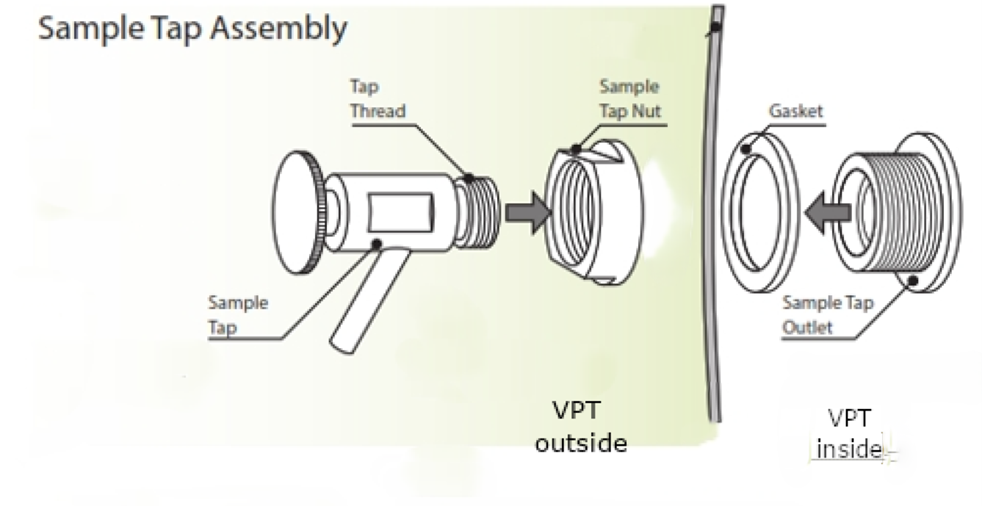
- Use of teflon plumber’s tape on the sample tap thread is recommended.
- Correct fitting of the sample tap (if fitted) is fitted in shown in the diagram below, with the Outlet and gasket on the inside of the VPT and the Nut and Sample tap on the outside.
CAUTION: The Teflon tip at the end of the sample tap spindle can be damaged by rough handling, dropping on concrete and through normal wear-and-tear. The Teflon tip is designed as a replaceable part and should be replaced every few years, and certainly if dripping occurs.
In the Cellar
Always keep fully topped
- Unless the wine is undergoing primary or malolactic fermentation, always maintain the VPT completely full, with no air gap.
- Fill through the 2” cap in the lid and not by removing the lid and fitting the lid after filling.
- Fill completely, to the top of the 2” hole in the lid
- Leaving an air gap will degrade FSO2, oxidize the fruit and allow spoilage bacteria to grow.
Use a Thread Protector and a loose fitted silicon bung or ferment trap if the wine is undergoing primary or secondary fermentation.
CAUTION: Using a tightly closed 2” cap during primary or secondary fermentation will create a pressure vessel!
Flexible Walls, Thermal Expansion & Contraction and Air Gaps
- The polymer walls are flexible and will stretch when first filled, then stabilize as pressures equalize. About 2 weeks after the first filling, the VPT must be filled / topped, as the polymer walls will have expanded outwards slightly, creating an air gap.
- If your cellar experiences high temperature variation, i.e. between summer and winter, night / day, expect the apparent volume of wine in your VPT to change as the wine expands and contracts. Adjust fill volumes accordingly.
Do Not Use Liquid Filled Expansion Chamber*
Wine filled expansion chamber devices (more common in France) exert uneven weight on the lid main seal and may cause leaks.
CAUTION: Do not use liquid filled expansion chambers. Such use will void warranty.
Treat Your VPT Like a Barrel – Follow These Three Simple Steps
- No Air Space – top regularly, typically every 4–8 weeks. (Same as a traditional barrel)
- FSO2 – maintain FSO2 levels the same as in a traditional barrel
- Reduction – if there is unwanted reductivity in the wine, rack-and-return (as we do in a traditional barrel)
After Use & Storing
Wash
- After use, clean and sanitize (including lid & any valve and sample tap) as per initial / first use, and store clean and dry.
- Dry storage does not require the use of SO2.
Storing
- VPT does not need to be stored with SO2 solutions or SO2 gas. Simply store clean & dry.
- VPT are UV stabilized and can be safely stored outside. To maintain perfect long life however, inside storage away from direct sunlight is recommended.